
BFT’s Founder, Sedtha Long, has worked side by side with families, youth, and stakeholders to establish BFT into a strong and impactful organization dedicated to uplifting and supporting all Cambodians.

Sedtha's Story
Sedtha was born in Battambang approximately in 1958 (Cambodians do not celebrate birthdays but take their ages from their first Khmer New Year in April each year). He moved with his family as a child to Phnom Penh, Cambodia’s capital city, in 1968.
When the Khmer Rouge invaded Phnom Penh on 17 April 1975, Sedtha was 16. Separated from his family not long afterwards, Sedtha survived the long hours of working in rice fields, looking after cows, and building two dams, in conditions of near-starvation and fear. He managed to survive by finding and eating insects and small animals.
In January 1979, Sedtha escaped to the Thai border, where he rescued 20 children he found along the way. During the next 12 years, he lived in more than 10 different refugee camps.
One of the few educated survivors of the Khmer Rouge years, Sedtha saw education as the key to rebuilding Cambodia. He taught children and adults in the camps and Western volunteers about Cambodia’s culture and history, which he still does today. He worked with the few Buddhist monks and nuns who had also survived the genocide to help Cambodians try to make sense of their collective experience and build meaningful lives for themselves and their children despite it.
Sedtha was forced to move camps frequently because of attacks from both the Khmer Rouge and the Vietnamese. Eventually, he moved to Site 2, one of the large United Nations camps across the Thai border, where he completed his first degree in education. He was the first Cambodian chosen to work with United, Nations agencies, which sponsored him for advanced studies in Thailand, Japan and the United States, specialising in education, psychology, methodology and community development. He also worked for the United Nations Transition Authority in Cambodia (UNTAC), which paved the way for democratic elections in May 1993.
Sedtha spent some time in various parts of Cambodia before deciding to settle in Siem Reap with his wife, Sek, children, foster children, and other extended family. He built a house with the help of his wife’s relatives in the United States and some foreign friends in several countries. He worked as the outreach manager for the Angkor Hospital for Children, but also taught free classes at his home, as well as helping children in need and reuniting them, if possible, with family members in surrounding villages. His home has never been an orphanage, but a place where children from troubled families have found refuge, most of them returning to their extended families.
His efforts inspired others to join him and culminated in his house becoming a center for care, support, and development known as the Build Your Future Today (BFT) Center.
Over the years, many, many people have called BFT home for some of their lives and remain part of a large extended family. As the work of BFT evolved and expanded into new initiatives and regions, that community has only continued to grow.
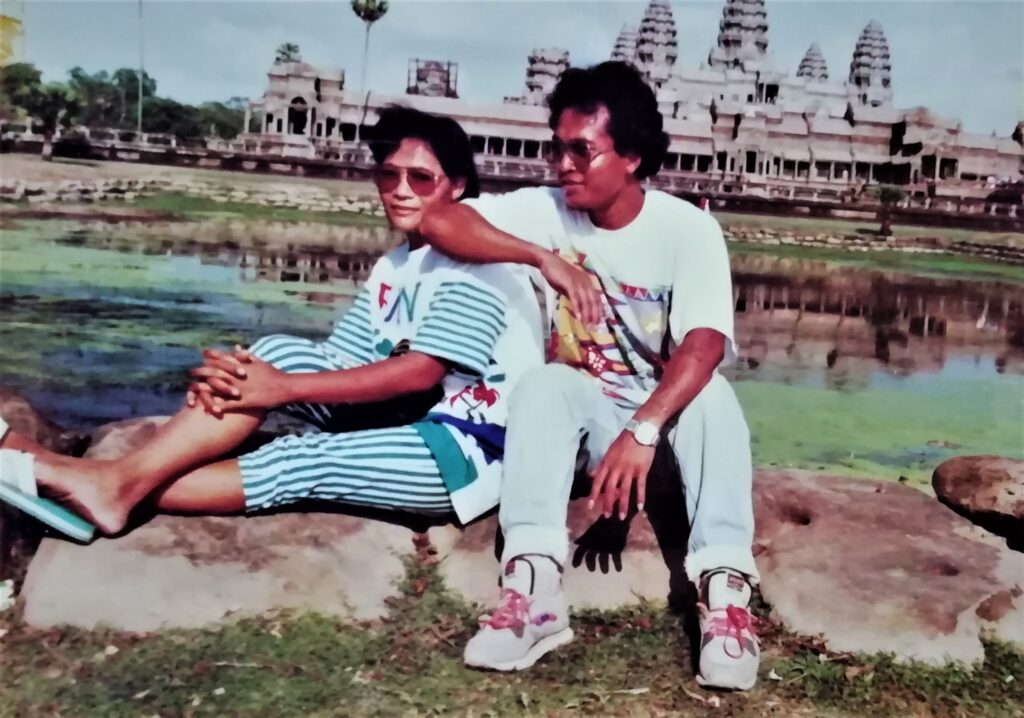
TRAGEDY AND TRIUMPH
Our founder has already left a significant mark and legacy in Cambodia, inspiring thousands to follow in his footsteps. Chad William’s book, Tragedy and Triumph, captures Sedtha’s story and one of the most significant times in Cambodia’s history. We welcome you to read to get more insight to our country’s complex and challenging history and why our work is so critical:
Click on the book to read Sedtha and BFT’s story